
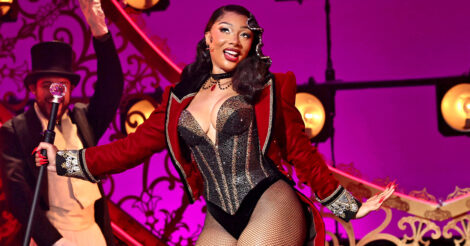
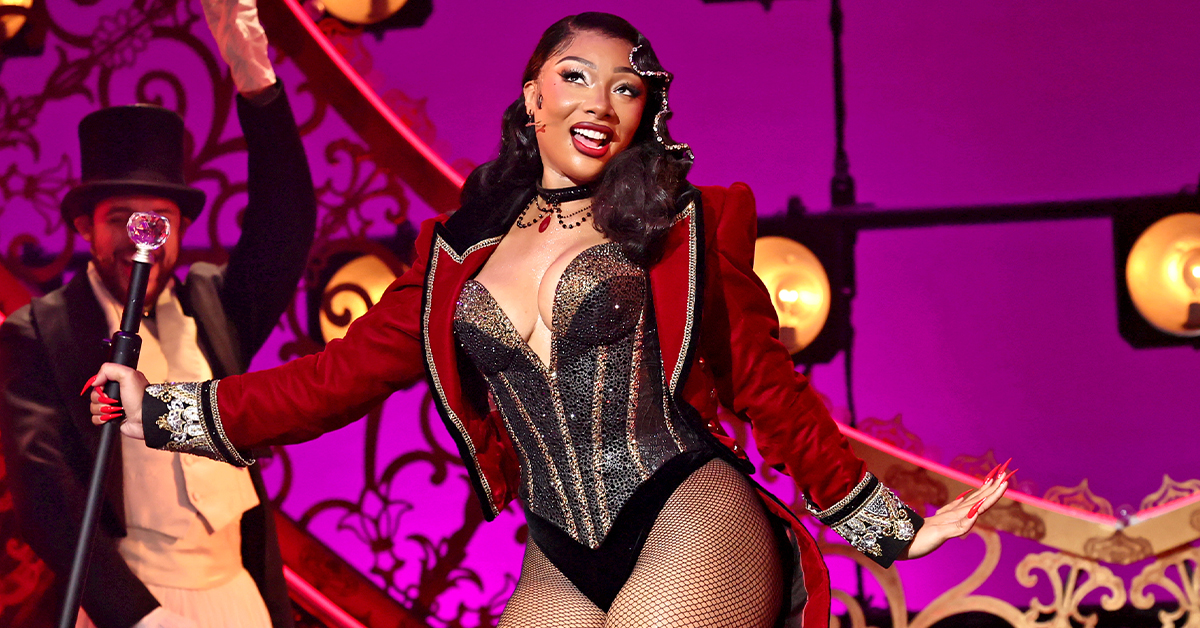
Megan Thee Stallion has officially added Broadway to her ever-expanding résumé—and she’s doing it on her own terms.
The Grammy-winning rapper made her highly anticipated debut in Moulin Rouge! The Musical on Tuesday (March 24), stepping into the role of Harold Zidler at the Al Hirschfeld Theatre. It’s a casting choice that feels both unexpected and perfectly aligned with Megan’s larger-than-life persona—commanding, theatrical, and unapologetically bold.
Her limited run, which continues through May 17, arrives at a pivotal moment for the Tony-winning production, which is preparing to close after a successful seven-year run. That timing gives Megan’s casting an added sense of occasion—less of a cameo, more of a moment.
And she made sure it felt like one.
During curtain call, Megan leaned into a long-standing Moulin Rouge! tradition, where performers playing Zidler are invited to incorporate their own musical identity into the role. Megan didn’t hold back, delivering snippets of her own hits including “WAP,” “Body,” and “Savage,” seamlessly blending her signature style into the theatrical world of the show.
It’s a move that underscores what makes her casting so compelling: she isn’t simply stepping into a role—she’s reshaping it.
Megan also makes history with the performance, becoming the first female-identifying performer to take on the role of Zidler in any production of Moulin Rouge! The Musical worldwide. It’s a notable shift for a character traditionally played by men, and one that reflects Broadway’s ongoing evolution toward more inclusive and fluid casting.
Before Megan, the role has been taken on by a diverse lineup of performers including RuPaul’s Drag Race winner Bob the Drag Queen, Boy George, Tituss Burgess, and Wayne Brady—each bringing their own interpretation to the charismatic nightclub impresario. Megan’s version, however, arrives with a distinctly modern edge, bridging pop culture and theater in a way that feels uniquely of the moment.
She joins a refreshed cast, including Kelsie Watts as Satine—who also began performances that same night—and Christian Douglas as Christian. The pairing marks a new chapter for the show’s final stretch, with Megan’s presence injecting renewed energy and attention into the production.
For Megan, the move into theater is less a departure and more an extension. Her performances have always leaned theatrical—whether through choreography, storytelling, or persona—and Broadway offers a new canvas for that expression.
It also signals something larger: a growing crossover between music, film, and live theater, where artists are increasingly moving fluidly between mediums without losing their identity.